Your Japanese isn't the problem. You're missing one layer: the Japanese that lives outside the textbook.
Join the newsletter and the $20 price unlocks instantly. Unsubscribe anytime. Or buy now for $25
By Kahn Murakami, a certified Japanese teacher with 3,000+ lessons taught.
You've studied vocabulary and grammar, maybe for years. Then you talk with Japanese friends, open LINE, TikTok, YouTube — and you're surrounded by Japanese your textbook never taught you.
A friend says it. You know every character. You still aren't sure how to read the tone.
It arrives on LINE. Is it casual? Curt? Would it be rude coming from you?
Someone comments it. The dictionary says "grass." That's not what it means here.
The translation usually isn't the hardest part. The real questions are: Do Japanese people still say this? Would I sound weird using it? Is it rude? That's the gap this book was built to fill.
Not necessarily. Both columns are Japanese. Textbooks usually teach only one of them.
Take やばい. A dictionary gives you "dangerous" or "bad." Japanese people use it like this:
The same word can feel like bad, amazing, crazy, or unbelievable. That's why this book doesn't stop at "what does this mean?" — it also teaches what it feels like, and whether you should use it at all.
There's another problem with learning slang online. You find an expression, memorize it, then discover it's outdated, it's rude, the nuance is different, or Japanese people don't actually use it that way.
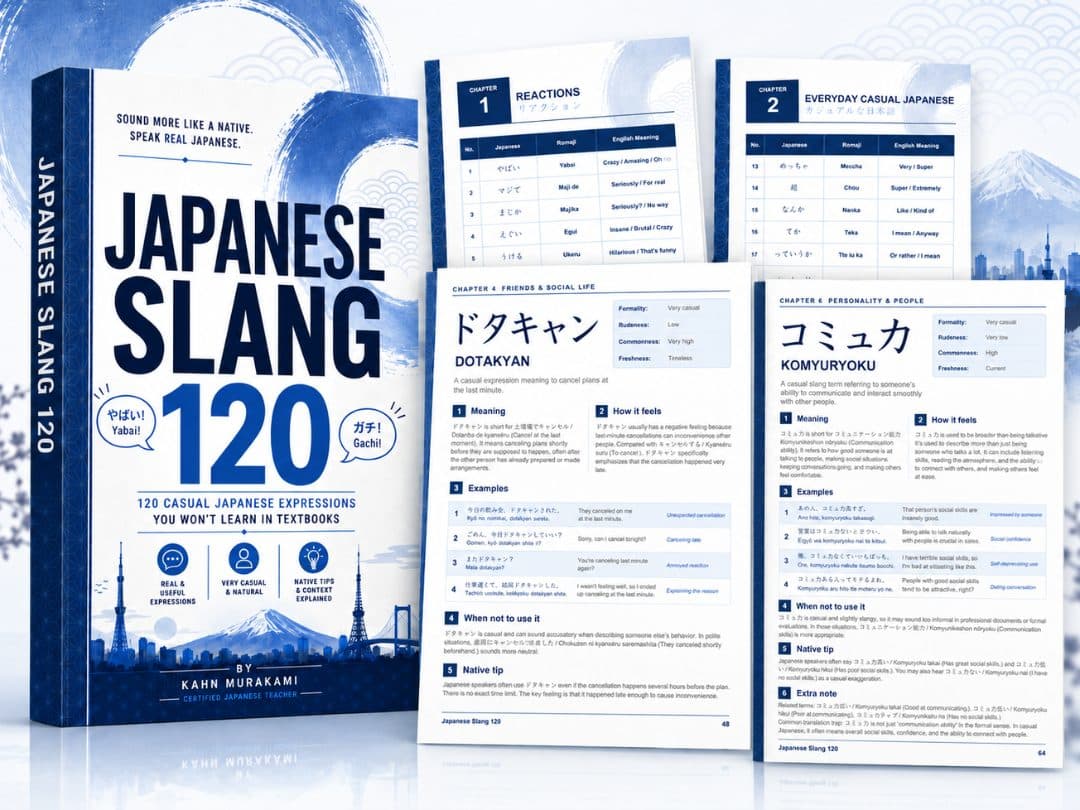
So every expression carries four ratings: how casual it is, whether it could offend, how commonly it's used, and whether it still sounds current.
Six things on every page, plus the four ratings.
What it actually means.
The nuance it carries to a Japanese speaker.
How it appears in actual conversation.
Who you shouldn't say it to, and when to avoid it.
The detail that makes your understanding more natural.
Related expressions and common translation mistakes.
You could memorize "hardcore fan" and stop. But who counts as ガチ勢? Do you have to be a professional? How is it different from オタク? Does it sound insulting?
It doesn't simply mean "beginner." It can suggest someone with surface-level knowledge who became a fan after something got popular — and it can sound slightly dismissive.
Similar to "lol" — but that doesn't mean Japanese speakers normally say "wara" out loud. It's primarily a written online laughter marker.
120 expressions across 10 categories. And no — not every one is technically "slang." It includes both slang and everyday casual Japanese, because your goal isn't to memorize linguistic categories. It's to understand the Japanese people actually use.
See an unfamiliar expression on TikTok? Look it up. Hear something from a Japanese friend? Check the nuance. Want to use one yourself? Check whether it fits. It's built to become your dictionary for real Japanese — not something you read once and forget.
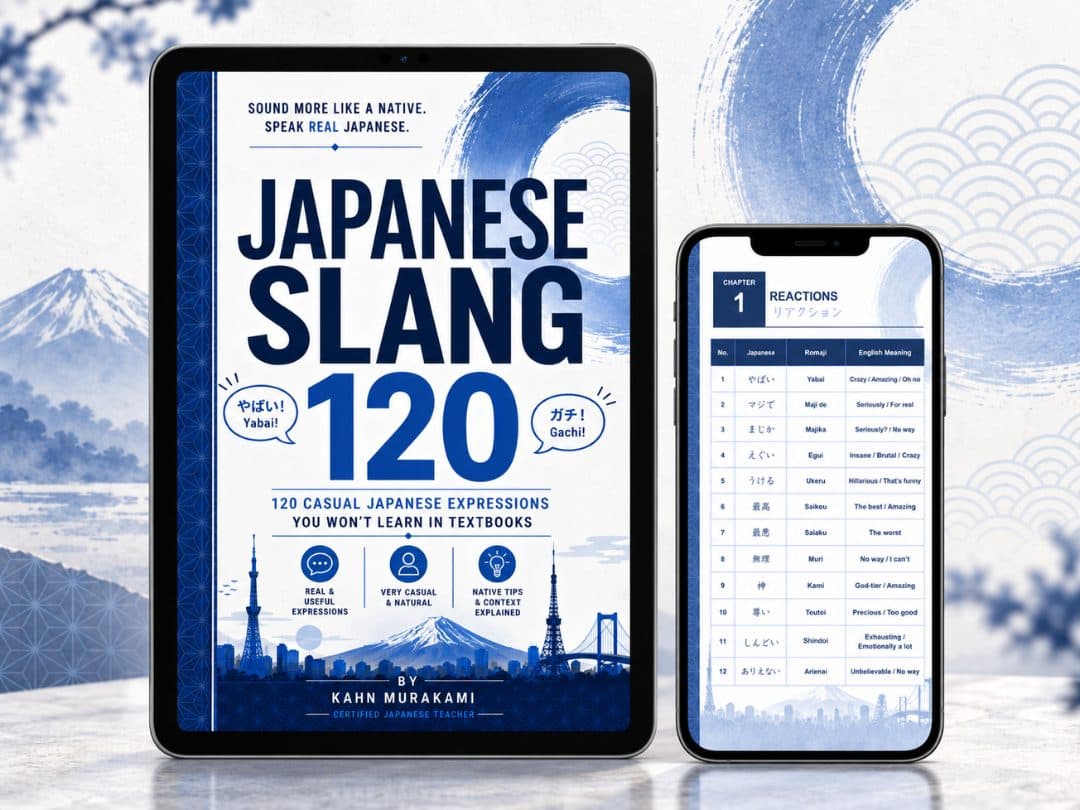
Japanese Slang 120 is a digital PDF. Phone, tablet, or computer — keep it with you and check an expression the moment you need it.


I think the design is great and very easy to follow. The detailed entry format is especially useful—you get the meaning, how each expression feels, real examples, formality, and more. I'd definitely recommend it to anyone who wants to understand casual Japanese beyond what you normally learn in textbooks.

I really enjoyed this book! It's a fun and practical way to learn the kind of Japanese you actually hear in everyday conversations. I especially like how Kahn Sensei's Japanese Slang 120 explains not just what each expression means, but how it actually feels and when you should use it. The examples feel current, natural, and much closer to real everyday Japanese than typical textbook phrases. I'd recommend it to anyone who wants to understand casual Japanese better and sound more natural.
This isn't Japanese for passing a test. It's Japanese for understanding people.
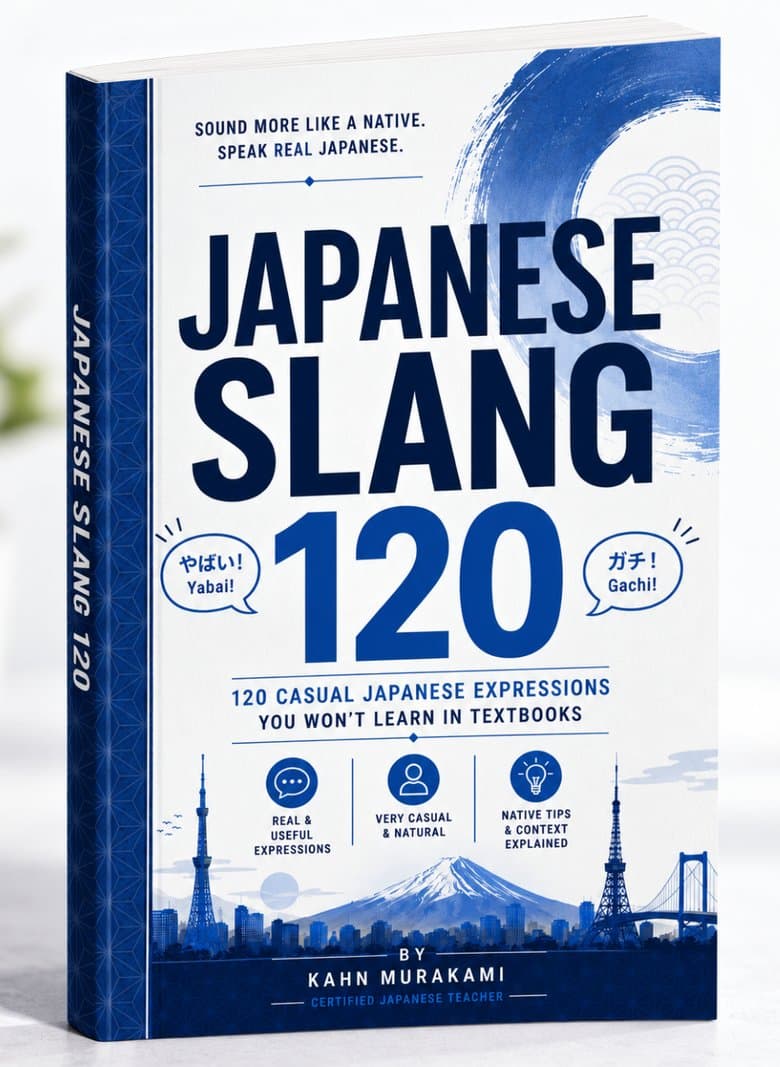
120 real Japanese expressions — what they mean, how they feel, when Japanese people use them, when you shouldn't, and whether they still sound natural today.

Prefer not to subscribe?
Buy now for $25The next time someone says
you have two options. Open Google again — or think: "I know that."
Japanese-learning emails included. Unsubscribe anytime.